
The Feedback Machine
I like it when people are happy. It makes this people-pleaser happy.
I recently scrolled upon a clip about bird murmurations, creating swirling shapes in the sky. It seems magical, but on a basic level, these birds have simply learned to stick together without bumping into each other. The resulting patterns exhibit a grand harmony of existence.
I could see my family in those swirling patterns, working hard to get along. Avoiding drama where possible. In fact, my kid brain did not like drama at all. Drama felt unpredictable and dangerous.
I preferred to fly in a careful domestic murmuration pattern, attempting to micro-manage every interaction within our house with the foolish notion that I could -- somehow as a child -- control the outcome of how others behave by collecting facial expressions and body language, and then saying the exact right thing. I felt like the main character living in a less affluent, and much less hilarious version of the Bluth family.
Even so, those experiences managed to pay off for me once I decided to write stories, which as fate would have it, requires creating drama instead of avoiding it.
It gets a bit more complicated when you learn that you have to develop your own voice, which does not work well if you stick simply to people-pleasing. On some level you have to figure out what makes you different from others. You have to learn to self-please.
I must read what I’ve written and see how it affects me. For example, I read that last paragraph, and immediately realize, “I’ve made a huge mistake.”
It does help to get feedback from others to know if something works at all, not just for self-pleasure, but the pleasure of the audience.

But seriously folks, getting feedback brings flashbacks of living in a domestic murmuration, where instead of keeping the peace of your current flight pattern, you must fly straight into the bird next to you.
As a result, before your work gets good, feedback can make you feel more like a people-disappointer.
My most infamous case of feedback came from an actual, real-life veteran TV producer who offered to read a script. An expert like that could give you the validation - and on the rare occasion, the coveted green light.
So, I made sure that script worked in every way. I worked with other writers, got notes from producers, and even conducted a table read with actors, some of whom would soon appear on the television, again in real life.
I got the feedback call on my way to work. That’s the one call that could not go to voicemail, so I answered, even though I probably should have been focusing on my upcoming freeway exit. He began with those magic words that make you instantly forget you’re driving 60 mph on the 405:
“If you’re going to call it a comedy, you might want to put some jokes in there.”
Good night everyone! You’ve been a great audience, and it’s been fun, but I must disappear from the earth now. Perhaps, some day you may find me warming up by a trash can fire deep in the forest preserve, but for now, I shall burst into literal vapor.
It was at that moment that I sailed through the guard rails in slow motion, flew over Sawtelle Avenue, and crashed into the Best Buy –- only on the inside, of course. I had heard plenty of working writers discuss the proper way to receive feedback as a professional. So, on the outside, I thanked him for the helpful feedback.
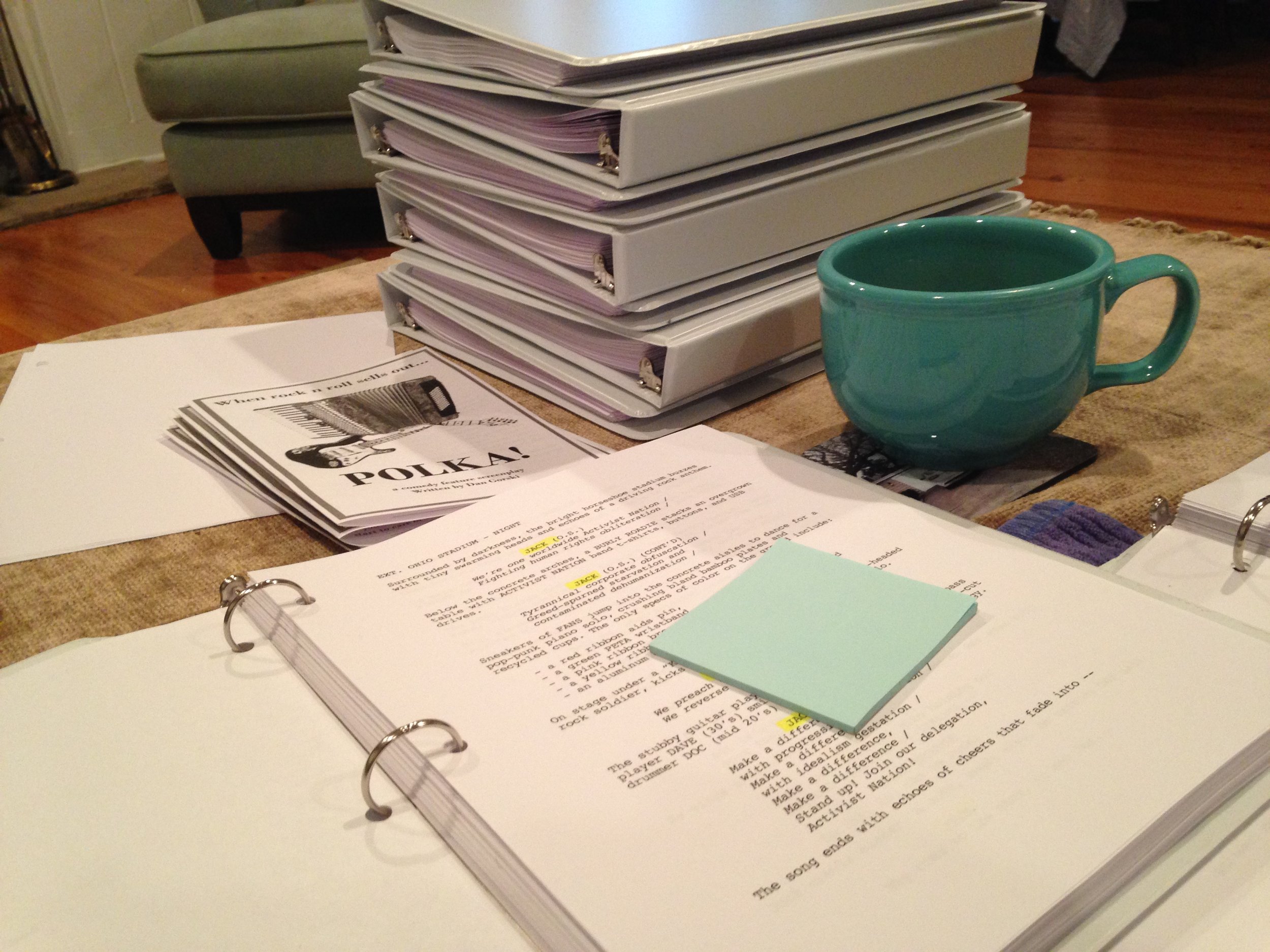
The table read still stands out as the best feedback machine because it costs the least, and you still get to hear the story played out with actors. You hear your words come to life, and experience it as an audience member.
It makes me feel like I’m in control, sensing the audience reaction and giving the feedback to myself, in a safe, self-inflicted disillusionment process. I can feel immediately what works and what deserves death by deletion squad.
Most of the time a table read confirms the script is not ready, and provides a good barometer for what needs fixing. When I wrote as part of a sketch team at the now permanently closed Improv Olympic West, we developed a rapid-fire system of trying out new sketches on a monthly basis. After a single read-through, the team would either give an enthusiastic nod to get it up on stage, or they would unceremoniously toss it in the trash with the swiftness of severed head falling from a guillotine.
A delightful skin-thickening and brain-sharpening good time!
Table reads can also provide the final test of reassurance that the script is ready enough to produce it or move on to the next script. When that TV producer heard the actors in our table read laughed throughout the script, he interrupted me, “Forget what I said. I don’t know what I’m talking about. The script could be ready.” What? Are you kidding me? I’ve seen your house. The one with the shelf full of awards.
He then confided in me that he doesn’t always get the jokes in the scripts when he reads them. However, he trusts the writers, because he can see the script working in the table read.
Proving once again that famous quote about Hollywood from William Goldman (screenwriter of ALL THE PRESIDENT’S MEN, THE PRINCESS BRIDE): “Nobody knows anything.”
And so, a feature film script of mine has reached that final stage before production. My producer team is helping gather a cast for a final table read, and I am finding a few other birds willing to fly right into me. One last chance to fire up the feedback machine!